
1. Define the change you want to give the reader in one sentence
Before production, write one sentence describing what the protagonist wants, what happens, and what changes at the end. For example: A bookseller learns how a customer feels from a clue in a forgotten item before closing time. Including a person, situation, and change makes it easier to choose the information each page needs before expanding the setting.
Then separate three points: what the reader needs to know first, what should surprise them in the middle, and what feeling they should take away at the end. Deciding the sequence of events you want to preserve is more useful for comparing and editing AI suggestions than simply making an instruction longer.
- Limit the protagonist to one goal
- Decide what situation the first page establishes
- Decide the feeling or question the ending leaves behind
2. Turn characters and the setting into reusable reference material
For each character, record more than a name and appearance: include their role, manner of speaking, relationships, and objective in the current scene. Organize clothing and props that should recur across pages as well. Lyra's character management can bring together appearance, personality, role, and reference images to create a foundation for continued use within a work.
Reference images are useful, but they do not promise perfectly identical output. State the conditions you want to retain in writing as well, such as hairstyle, clothing features, apparent age, and expression tendency, then compare results across pages after generation. For the setting, briefly record the era, location, light, objects, and elements to avoid so that decisions are faster from scene to scene.
- Give every character an objective for the scene
- Limit recurring visual features to a small set
- Review reference images together with written settings
3. Divide prose into scenes and decide each scene's job
Divide the story where the location, time, or a character's objective changes. Give each scene a clear answer to who does what and learns what. When exposition runs long, breaking it into action, reaction, an object close-up, or silence helps you choose what to show as manga.
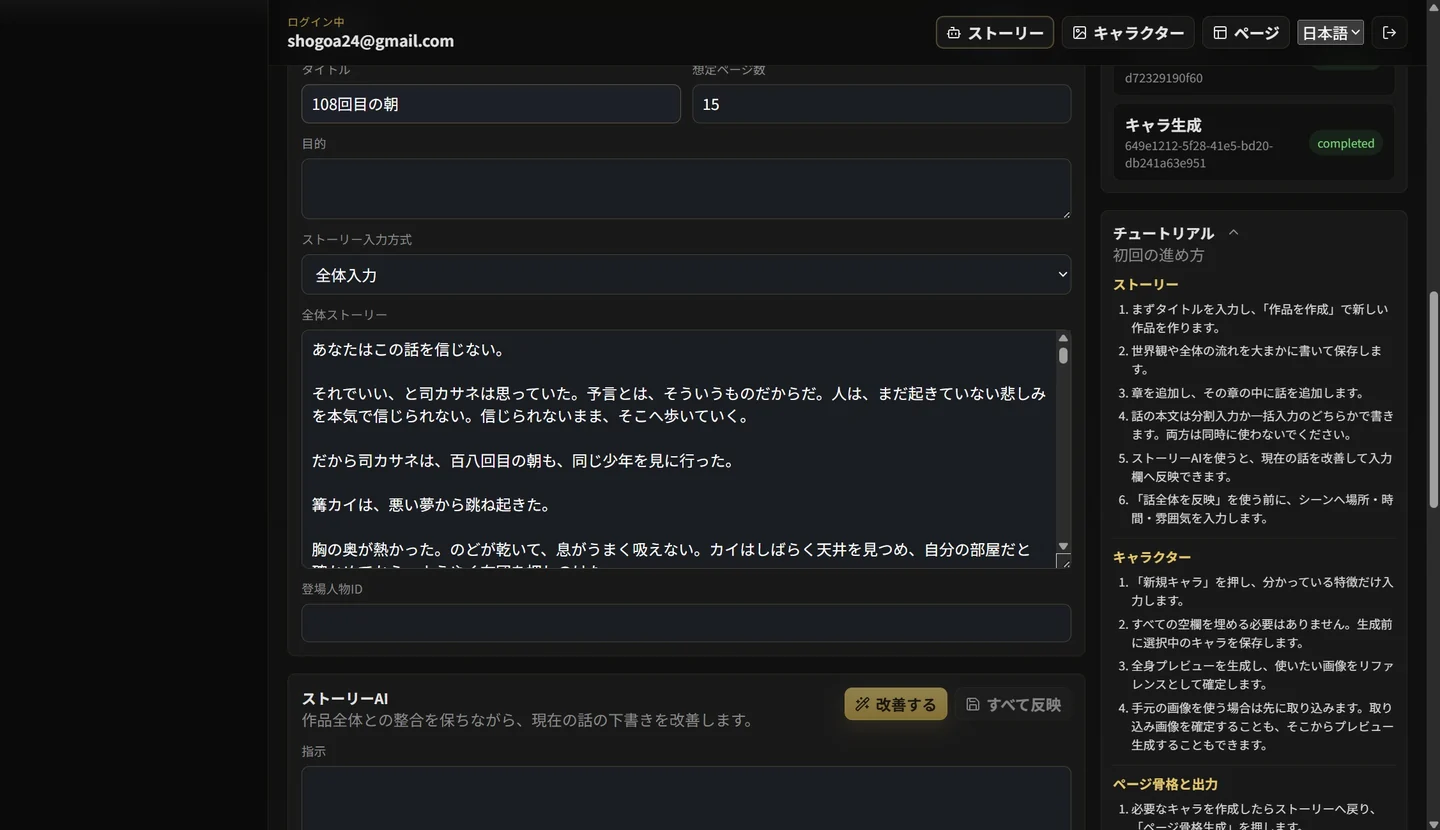
In Lyra, an entered story can be organized step by step into scenes, pages, and panels while considering transitions, characters, and dramatic intent. Treat a suggested division as a draft. The author should check whether the protagonist's choice is visible and whether the reader can still follow the location.
- Give each scene one small change
- Show a location or time cue at transitions
- Check whether exposition can become action or reaction
4. Design reading order with pages and panels
For every page, decide one thing the reader should understand by the time they finish it. Then assign setup, action, reaction, and a pull into the next page to individual panels. Large panels work well for an emotional moment or an impression of place, while smaller panels can show a sequence or the rhythm of dialogue, helping you control the speed of the reader's eye.
In Lyra, you can edit the characters, backgrounds, camera angles, dialogue, and panel content proposed by AI before proceeding to generation. Decide whether to adopt a proposal by comparing it with the page's purpose. Briefly checking character, action, background, framing, and emotion for every panel keeps later revisions local.
- Decide the information left at the end of the page
- Give each panel one main action
- Reread reading order and dialogue volume one page at a time
5. Treat generation as the start of editing, not a completion check
Page generation can support manga page production from the organized character, scene, and panel information. When reviewing a result, first check story comprehension, then whether characters can be distinguished, and finally whether framing and dialogue are readable. Do not try to fix everything at once; identify which panel and which issue prevents the page from serving its purpose, then edit it.
Output varies from one generation to another, and intent, composition, dialogue placement, or character reproduction may not match expectations. Test settings and direction on small pages, then keep feeding adopted decisions into the next page. This back-and-forth makes it easier to maintain the direction of the whole work. When using materials or settings, review their conditions of use and check Lyra's notices and terms for rights guidance.
- First check whether the page serves its purpose
- Review characters, backgrounds, framing, and dialogue panel by panel
- Read text and images together before publishing and record needed revisions