1. Limit memorable traits to three through five
Too much information makes it unclear what should take priority. Choose three to five traits from hair shape, eyes, build, clothing impression, and props that let a reader distinguish the character at a glance. Make each trait comparable: rather than short black hair, write black hair that is longer only on the right side.
Also decide on one standard each for speech, posture, and a habitual action. Writing down what changes and what does not when the character is angry or tired helps retain their identity without relying on facial expression alone.
- Choose three to five visual traits
- Write short standards for speech and posture
- Separate elements that may change from elements to preserve
2. Make a character sheet you can use in scenes
A profile alone is not enough to make decisions while creating pages. For each character, separate their role in the work, current objective, relationship with the other person, what they know, and what they hide. The same person changes expression and language depending on whom they are with.
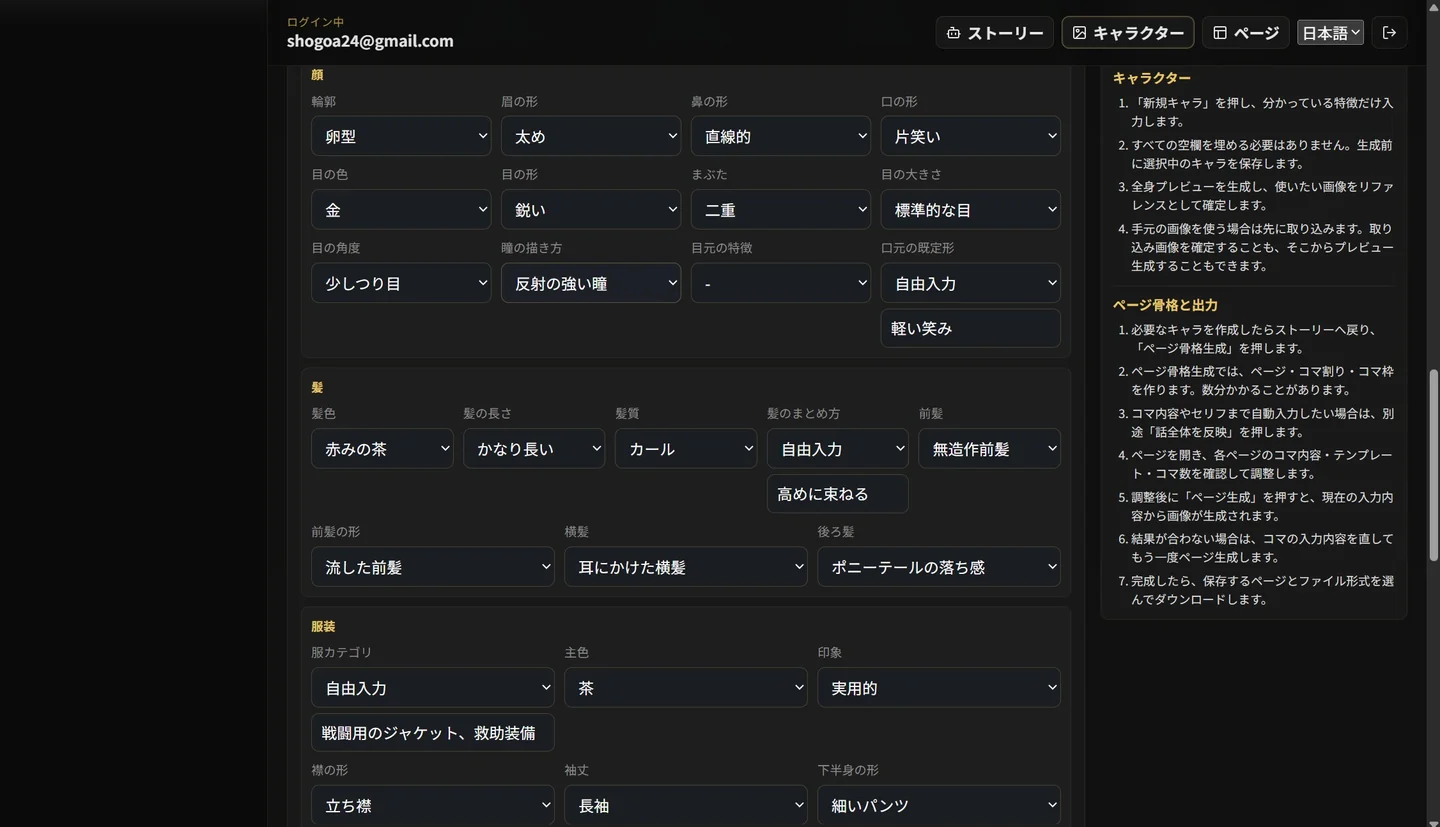
Lyra's character management can collect appearance, personality, role, and reference images for continued use during production. Before creating a page, review only the characters in that scene and add a brief statement of what each person wants in the panel. This makes both AI proposals and author edits more concrete.
- Write role and current objective separately
- Check the relationship and distance for each counterpart
- Reduce each character's reason for acting in a scene to one sentence
3. Pair reference images with written settings
Reference images can communicate direction for hairstyle, features, clothing, color, and texture. Choose images that let you check the angles or expressions you need, such as front view, profile, full body, or expression variations. Do not make every accidental background or prop in a single image a required condition; supplement the elements to retain with words.
Lyra can support page-to-page production while referring to character images and work materials. Even with a reference image, do not trust a result blindly. After generation, compare hair, clothing, apparent age, build, and facial impression against the prior page. When you find drift, first return to the character setting or panel direction and isolate where it originated.
- Choose material that shows the angles or expressions you need
- Specify retained traits in words as well
- Do not confuse accidental image details with required conditions
4. Check continuity across pages
Place adjacent pages side by side and check clothing, props, injuries or dirt, time of day, and the characters' spatial relationship. Readers are especially likely to feel a mismatch during an ongoing conversation, immediately after movement, or just before a major emotional shift. Continuity is not only a matter of a face in a still image; judge it through the order of events as well.
A fixed checklist reduces omissions. On each page, record who is present, what they carry, where they look, and what they know, then compare it with the next page. Reviewing in groups of two or three pages makes the impact of changes easier to track than making large revisions only after every page is complete.
- Compare clothing, props, injuries, and time of day between pages
- Check changes in character knowledge and emotion
- Review differences in small groups of pages
5. When you find drift, revise from the smallest likely cause
When a character looks different, you do not need to remake the entire work at once. Separate whether the issue comes from the character setting, reference material, scene objective, panel framing, or generated result. If only the appearance of the face is an issue, check identifying traits and framing. If the dialogue feels unlike the character, check speech style and objective.
With AI-assisted production, the same input can produce different results. Keep adopted pages as a reference and briefly record what you changed. Rather than aiming for absolute sameness, aim for a state in which readers recognize the same person and the character's actions and emotions connect through the story. That goal is more useful for real editing decisions.
- Separate settings, material, panels, and results as possible causes
- Change only a small number of conditions at a time
- Keep the adopted standard and reason for revision